This blog I will be offering up my thoughts on Colwood and sustainability and if it can ever happen. I will answer with a resounding NO! Never before in all my travels have I seen so many large 4x4 pick up trucks, in an area that does not receive rain in the summer or snow in the winter. I don’t see many bicycle riders.
The so called evil box stores are always busy and the parking are always full, with large pick ups of course. I cannot see how a place like this can ever hope to become something close to sustainable. Lets not forget about the untreated waste that is dumped directly into the ocean.
Victoria and Colwood, like any other community in North America, are built around the car. I have only taken public transit 4 times since moving here 6 months ago from Toronto. Riding public transit to get anywhere aside from downtown is not practical. Buses on some routes only run once every 30 minutes, the signs at bus stops aren’t clear, a student pass is not much cheaper then a standard monthly pass, the list goes on and on.
I ride my bicycle to and from school and the grocery store, which happens to be one of those evil big box stores. I find it funny that we’re encouraged to boycott big box stores, and support local small business instead. But in the case of the Great Canadian Superstore, its Canadian owned, so isn’t that considered local? Also, some of products they sell are locally grown, so once again, that’s me supporting local business.
The idea of locally grown food is another farce. Thanks to the global food trade, we can have certain luxuries, such as oranges and strawberries in January. If we subscribe to the idea of locally grown food, that means meat, potatoes, turnips, and cabbage for every meal for 6 months. Greenhouses might offer some variety of fruit and vegetables, but at a high price.
I could go on and on with a rant, but instead I will try to be positive.
I don’t think that making people feel guilty about their consumption and habits is the way to achieve something resembling sustainability. Instead, some incentives should be used. Maybe some radical thinking, like using GPS logging to track people to see if driving decreases, or highlighting local food at big box stores, so people are not looked down upon for shopping there.
Even where I currently live could use improvements. The house was build in the 70’s from the looks of it, and could use some upgrades to increase energy efficiency. Double paned windows, thicker curtains, and some extra caulking could help minimize heat loss and decrease drafts. Aerators on faucets and composting would reduce water usage as well as garbage. Using backyard gardens can decrease food consumption and provide people with the knowledge of sustainable living and gardening.
I think many different small steps, on many different areas of sustainability is what is needed, instead of a limited focus.
Saturday, March 20, 2010

Wiki and project planning
A wiki is a great way for a group of people to collaborate on a group project. It is a webpage that anyone can access and edit to display information on 1 or a variety of topics. Wikipedia is probably the most famous wiki that comes to mind. We were introduced to creating a wiki for the purpose of using it to host our project dealing with the mapping of the trails on Royal Roads University.
We got introduced to doing Wiki’s as our project that we are presenting to the town of Colwood will be placed on a Wiki site and presented. We were given two main devices to help us with our project. The first is a website called tools of change. The webpage is helpful in the initial stages of the project. It has many helpful ideas to develop objectives, partners, informing people, targeting the correct audience, and choosing tools of change.
The 2nd device given was the ADDIE model. Addie stands for
• Analysis
• Design
• Develop
• Implementation
• Evaluate
This approach made it easy to get the project underway. Its very straightforward. The first step of the ADDIE model is to determine what the underlying issue is. The second step is design a prototype model, apply strategies according to the intended outcome, and narrow down the subject matter. The development stage is to determine the process as to how the project will be completed. The implementation stage is when everything comes together and a working model is produced. The 5th and final stage is used to evaluate the working model, and correct any errors found.
My part of the ADDIE model is the evaluation portion. So I will be tasked with going over everyone’s work, and finding any suggestions and room for improvement. I feel that this is a good role for me, as I am usually fairly critical work people’s work, so I shouldn’t have any problems finding areas for suggestions.
We got introduced to doing Wiki’s as our project that we are presenting to the town of Colwood will be placed on a Wiki site and presented. We were given two main devices to help us with our project. The first is a website called tools of change. The webpage is helpful in the initial stages of the project. It has many helpful ideas to develop objectives, partners, informing people, targeting the correct audience, and choosing tools of change.
The 2nd device given was the ADDIE model. Addie stands for
• Analysis
• Design
• Develop
• Implementation
• Evaluate
This approach made it easy to get the project underway. Its very straightforward. The first step of the ADDIE model is to determine what the underlying issue is. The second step is design a prototype model, apply strategies according to the intended outcome, and narrow down the subject matter. The development stage is to determine the process as to how the project will be completed. The implementation stage is when everything comes together and a working model is produced. The 5th and final stage is used to evaluate the working model, and correct any errors found.
My part of the ADDIE model is the evaluation portion. So I will be tasked with going over everyone’s work, and finding any suggestions and room for improvement. I feel that this is a good role for me, as I am usually fairly critical work people’s work, so I shouldn’t have any problems finding areas for suggestions.
Community Based Social Marketing
Community Based Social Marketing (CBSM) is a concept that works on the idea that information is not enough to change behavior of people. Instead, it actually engages the community in a way of showing benefits and techniques that can be used to achieve goals for a great social good.
The advantage of social marketing is that it targets people in communities that are ready and willing for a change. CBSM isn’t just another advertising campaign, but rather a strategically planned out message to target a specific audience.
To facilitate change, there needs to be a goal in mind, and therefore some questions need to be asked to help develop successful plan
1. What is the social and environmental problems that need to be addressed
2. What actions can be taken to address these problems properly
3. Address who your audience is and how you are asking them to take action
4. What kind of exchange does the audience want for adopting the new behavior
5. How will you make the audience believe what you are offering is real and true
6. Who is your competition and what are they offering opposed to your concept
7. What is the best time and place to reach and intrigue your audience
8. How often and from who does the concept have to be presented
9. How can I integrate the audience to influence their behavior
10. Do I have the resources needed to create this concept alone; and if not, where can I find useful partners
After the 10 initial questions are tackled, the campaign experiences five steps that benefit the community marketing and allows the model to adapt to different situations. Any possible barriers and benefits can be examined on a case by case basis. Literature research, focus groups and surveys can be performed to gather information. Once the possible barriers have been identified, emphasis can be placed on correcting or avoiding them.
After this, a pilot program can be run and tested and evaluated. The initial testing is vital because the results can be compared to expected results and then adjustments can be made as necessary.
The fourth step is implementing the project after all the changes have been made. A project that has been evaluated will have a success rate when compared to a project that has not given appropriate attention to potential problems
The advantage of social marketing is that it targets people in communities that are ready and willing for a change. CBSM isn’t just another advertising campaign, but rather a strategically planned out message to target a specific audience.
To facilitate change, there needs to be a goal in mind, and therefore some questions need to be asked to help develop successful plan
1. What is the social and environmental problems that need to be addressed
2. What actions can be taken to address these problems properly
3. Address who your audience is and how you are asking them to take action
4. What kind of exchange does the audience want for adopting the new behavior
5. How will you make the audience believe what you are offering is real and true
6. Who is your competition and what are they offering opposed to your concept
7. What is the best time and place to reach and intrigue your audience
8. How often and from who does the concept have to be presented
9. How can I integrate the audience to influence their behavior
10. Do I have the resources needed to create this concept alone; and if not, where can I find useful partners
After the 10 initial questions are tackled, the campaign experiences five steps that benefit the community marketing and allows the model to adapt to different situations. Any possible barriers and benefits can be examined on a case by case basis. Literature research, focus groups and surveys can be performed to gather information. Once the possible barriers have been identified, emphasis can be placed on correcting or avoiding them.
After this, a pilot program can be run and tested and evaluated. The initial testing is vital because the results can be compared to expected results and then adjustments can be made as necessary.
The fourth step is implementing the project after all the changes have been made. A project that has been evaluated will have a success rate when compared to a project that has not given appropriate attention to potential problems
Open Space
Today as I walked into the classroom, I was greeted with an unexpected sight. The entire class was seated in a circle. I thought a big round of Kumbaya was about to begin; unfortunately (or fortunately), this did not occur. Instead, I was treated to the “open space” concept. Open space is designed to encourage creativity and allow people (students in this case) to come up with ideas and allow others to gravitate towards them.
Rick instructed us to write our ideas of how Colwood can become carbon neutral on large sheets of paper, and post them on the board. However feels strongly with any particular project can then join that project, or, if nothing of interest is available, anyone is free to make their own.
Rick described open space as whatever happened was the only thing that could have happened, and whoever joined in on the projects were the only ones who should have. He also described the law of 2 feet, and that people were able to use their 2 feet to decide where they wanted to be.
My 2 feet brought me to a group planning to map out Colwoods bicycle trails. We quickly decided that this was too daunting of a task. We decided to just map out the trails of Royal Roads University, which seems a much more reasonable concept.
I planned to procure a GPS from the school and test it out before actually mapping out the trail system.
Rick instructed us to write our ideas of how Colwood can become carbon neutral on large sheets of paper, and post them on the board. However feels strongly with any particular project can then join that project, or, if nothing of interest is available, anyone is free to make their own.
Rick described open space as whatever happened was the only thing that could have happened, and whoever joined in on the projects were the only ones who should have. He also described the law of 2 feet, and that people were able to use their 2 feet to decide where they wanted to be.
My 2 feet brought me to a group planning to map out Colwoods bicycle trails. We quickly decided that this was too daunting of a task. We decided to just map out the trails of Royal Roads University, which seems a much more reasonable concept.
I planned to procure a GPS from the school and test it out before actually mapping out the trail system.
Thursday, March 18, 2010
Land Usage & Urban form / Food
Gene Miller was the first guest of the morning. He is from the Center for Urban Innovation. I thoroughly enjoyed his presentation, although Rick Kool didn’t seem to agree with it, and vocalized his displeasure , after Gene had left the room.
Gene Miller was more a “doom and gloom” type guy. I found his outlook to be very refreshing compared to the usual tripe of rainbows, butterflies, and sustainability, that we are normally fed with. Gene discussed late stage capitalism and how it has effected our ability to resilient to change.
I completely agree with Gene and his viewpoint. Our society has become too reliant on technology to supply our needs, be it transportation, food, or environmental, at the cost of our planet. Gene summed up his viewpoints and presentation with one interesting quote A quote that Gene said sums climate change very appropriately; “The metabolism of our economy is on a collision course with the metabolism of our planet”
I feel this is a very true quote. Gene is describing our increasing consumption habits, and need to drive the economy, being in conflict with the “synergy” of the planet. Oil is being removed from the planet much faster then it is being replenished, regardless if someone subscribes to the abiotic oil theory, or the conventional dead dinosaur theory.
We then heard from Cindy Moyer of Colwood Climate Action and Jennifer Girard of Capital Families who both discussed issues of bringing food security to the Colwood community and surrounding areas. Food security and community resistance go hand in hand. In order a community to be sustainable, food needs to be at the top of the list, since people eat 3-5 meals per day.
One way of increasing food security is to use available land for food, similar to the Green Belt in Ontario he B.C was a pioneer in this idea, using the ALR, Agricultural Land Reserve, which set aside 4.7 million hectares in 1976. This is a good way of preserving existing farm land, but doesn’t address what can be done at a local level.
Jennifer Girard of Capital Families, introduced the idea of the Gardening Neighbourhood Project. This will allow people who want to get involved with growing their on food, but are unfamiliar with how to implement it, to contact an experienced gardener to guide them and help them set up the garden. I feel this an excellent idea to start people thinking about local food and actually implementing small scale gardens which will help contribute to sustainability.
Saturday, February 6, 2010
Sustainable Transportation
Transportation is one of my favourite topics. I have worked for the Toronto Transit Commission http://www3.ttc.ca/ for the past 3 summers, and I am an avid motorcyclist. I feel that discussing transportation is one of my strengths, however, making it sustainable will be a challenge to discuss, but I’ll give it my best.
Call this a general sweeping statement, but people love their cars, and to get people out of their cars is not to far off from the famous Charlton Heston quote “From my cold dead hands”. Cars, in my opinion, represent freedom, a way to escape from our troubles, and gives a sense of familiarity. Some friends of mine, myself included, love to pack a lunch, get in (or on) our vehicles, hit the open road without a map or any sense of a direction, and go where the wind shall take us.
To get people out of their cars and onto public transit is no easy feat. A suitable replacement for the comfort and warmth of a personal vehicle must exist, but unfortunately, in most North American cities, such a replacement is only a transit fans wet dream.
The speaker, Todd Litman, in class shared the same vision as myself. I found it comical though when he was describing how someone might possibly catch a bus in the not too distant future. Someone sitting in a coffee shop (where else to hippies hang out aside from coffee shops?) would see a LED board on the wall saying the next bus is due in 3 minutes, then he take his coffee (over priced mind you), gets on the bus, pays with a smart card, and is whisked away to transit paradise.
Those ideas are already implemented in Europe, and North America is about 30 years behind in technology and innovation.
Most buses aren’t exactly the epitome of efficiency. They’re loud, uncomfortable, infrequent, and don’t add anything to working business class person’s commute. If a Wifi connection is available, it might make taking the bus a little more appealing to someone who wants to catch up on work during a commute. More comfortable seating and sound dampening would also contribute. Of course, the human element on the bus cant be controlled, but who knows, maybe a first class section on a double decker bus could be implemented for people who want to pay a little bit extra to have peace and quiet.
Of course, those are all nice ideas for the vehicle itself, but it still doesn’t solve the problem of the commute time. I think a lane on the any highway should be ”removed” and turned into a dedicated bus ROW (right of way) so that buses don’t need to travel with traffic, and will become the envy of all the people stuck along the highway.

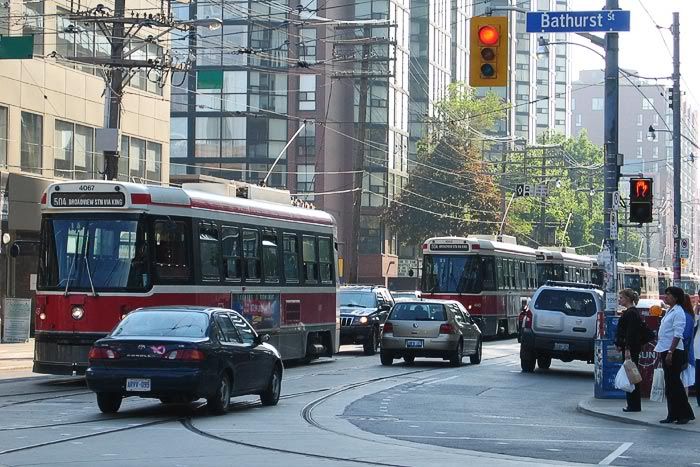
LRT (light rail transit) is another excellent way of getting people out of their Ford F-450’s. In my home town, the center of the universe, Toronto, the TTC has streetcars, which are a form of LRT but suffer the same fast as cars in the downtown core, since there is no separation from cars. Streetcars get stuck in traffic and end up become slow moving pylons. As mentioned before, I believe the answer to this problem once again lies in a dedicated transit lane so that regular car traffic isn’t a hindrance.

In a perfect world, everyone would ride motorcycles and not have to worry about taking up a lot of space on the road or searching for parking spots, but alas, this is Canada, with winter, so my little Utopian idea wont come to pass.
Call this a general sweeping statement, but people love their cars, and to get people out of their cars is not to far off from the famous Charlton Heston quote “From my cold dead hands”. Cars, in my opinion, represent freedom, a way to escape from our troubles, and gives a sense of familiarity. Some friends of mine, myself included, love to pack a lunch, get in (or on) our vehicles, hit the open road without a map or any sense of a direction, and go where the wind shall take us.
To get people out of their cars and onto public transit is no easy feat. A suitable replacement for the comfort and warmth of a personal vehicle must exist, but unfortunately, in most North American cities, such a replacement is only a transit fans wet dream.
The speaker, Todd Litman, in class shared the same vision as myself. I found it comical though when he was describing how someone might possibly catch a bus in the not too distant future. Someone sitting in a coffee shop (where else to hippies hang out aside from coffee shops?) would see a LED board on the wall saying the next bus is due in 3 minutes, then he take his coffee (over priced mind you), gets on the bus, pays with a smart card, and is whisked away to transit paradise.
Those ideas are already implemented in Europe, and North America is about 30 years behind in technology and innovation.
Most buses aren’t exactly the epitome of efficiency. They’re loud, uncomfortable, infrequent, and don’t add anything to working business class person’s commute. If a Wifi connection is available, it might make taking the bus a little more appealing to someone who wants to catch up on work during a commute. More comfortable seating and sound dampening would also contribute. Of course, the human element on the bus cant be controlled, but who knows, maybe a first class section on a double decker bus could be implemented for people who want to pay a little bit extra to have peace and quiet.
Of course, those are all nice ideas for the vehicle itself, but it still doesn’t solve the problem of the commute time. I think a lane on the any highway should be ”removed” and turned into a dedicated bus ROW (right of way) so that buses don’t need to travel with traffic, and will become the envy of all the people stuck along the highway.
LRT (light rail transit) is another excellent way of getting people out of their Ford F-450’s. In my home town, the center of the universe, Toronto, the TTC has streetcars, which are a form of LRT but suffer the same fast as cars in the downtown core, since there is no separation from cars. Streetcars get stuck in traffic and end up become slow moving pylons. As mentioned before, I believe the answer to this problem once again lies in a dedicated transit lane so that regular car traffic isn’t a hindrance.
In a perfect world, everyone would ride motorcycles and not have to worry about taking up a lot of space on the road or searching for parking spots, but alas, this is Canada, with winter, so my little Utopian idea wont come to pass.
Sustainability & Municipalities
Blog 3 Sustainability and the Municipality
To achieve sustainability, an effort must be made at all levels of government, as well as personal accountability.
Municipalities can play a vital role regarding increasing community and local sustainability. Although they have no direct control over transportation, which usually falls under the provincial umbrella, they can still assist it. Municipalities can encourage bus only lanes, and car-pooling.
Bicycle lanes and parking is usually the responsibility of municipalities. All new business and even existing ones should be forced to install bike racks to promote bicycle usage. Heavy bicycle traffic areas should be designated with bicycle specific lanes and on road grade separation so that bicyclists don’t directly share the road with cars. The municipality can offer a discount on helmets and lights to encourage their purchase. In addition, certain days can be dedicated to bicycle maintenance classes and rider training.
One of the biggest contributions that I believe municipalities can give to sustainability is the promotion of local business. It goes with the slow city idea to promote local food and business. The municipality, especially a small one such as Colwood, could start a bi monthly newsletter highlighting different business within the town. The local business can then demonstrate how they are sustainable and the benefits of purchasing local products and supporting local businesses. Again, this idea goes back to the slow city movement. Community events are organized at the municipal level. Local citizens and business can support one another towards sustainability.
Community gardens and tree planting initiatives can provide much needed green space and provide a source for local and sustainable food.
I feel I’m being too repetitive in this blog, most of what the municipality can add to sustainability has been mention in previous blogs, the slow city movement and transition town sum up what can be done.
To achieve sustainability, an effort must be made at all levels of government, as well as personal accountability.
Municipalities can play a vital role regarding increasing community and local sustainability. Although they have no direct control over transportation, which usually falls under the provincial umbrella, they can still assist it. Municipalities can encourage bus only lanes, and car-pooling.
Bicycle lanes and parking is usually the responsibility of municipalities. All new business and even existing ones should be forced to install bike racks to promote bicycle usage. Heavy bicycle traffic areas should be designated with bicycle specific lanes and on road grade separation so that bicyclists don’t directly share the road with cars. The municipality can offer a discount on helmets and lights to encourage their purchase. In addition, certain days can be dedicated to bicycle maintenance classes and rider training.
One of the biggest contributions that I believe municipalities can give to sustainability is the promotion of local business. It goes with the slow city idea to promote local food and business. The municipality, especially a small one such as Colwood, could start a bi monthly newsletter highlighting different business within the town. The local business can then demonstrate how they are sustainable and the benefits of purchasing local products and supporting local businesses. Again, this idea goes back to the slow city movement. Community events are organized at the municipal level. Local citizens and business can support one another towards sustainability.
Community gardens and tree planting initiatives can provide much needed green space and provide a source for local and sustainable food.
I feel I’m being too repetitive in this blog, most of what the municipality can add to sustainability has been mention in previous blogs, the slow city movement and transition town sum up what can be done.
Wednesday, January 27, 2010
Community based research and engagement
Today, January 21, 3 people came to our class. The first two guests were Sarah Webb, from the Capital Region District (CRD) and Jordan Fisher from Jordan Fisher and associates. Sarah Webb (who is also my sponsor in our major projects) discussed community engagement, the CRD’s climate action program and the 4 goals of the program.
I believe community engagement is an important issue to tackle. It gives people a sense of community (duh) and can also increase social capital, a term I learned from last quarters sustainability program. Sense of community and community engagement, to me, means knowing you’re a member of a particular group, and making positive contributions toward the betterment of the community.
I play an active role on my community back home in Toronto. I try to clean up garbage whenever I see it. I email local business and industries inquiring about their pollution and other possible adverse affects as a result of their operation. I communicate, on occasion, with city councilors, with whatever issues are going on in my community.
Sarah also mentioned the climate action program (CAP). The CRD plans to be carbon neutral by 2012. I don’t think they are anywhere near reaching that goal in the 2 years left until that date. Perhaps the CRD is hoping on some sort of Armageddon scenario in 2012 and the 4 horseman will break the seven seals of climate change to destroy all the carbon in the region. An unlikely scenario, but there is a better chance of pale horse riding out of the sky then a government in Canada actually meeting a goal it set out.
The third guest of the day was Maeve Lydon. She works at UVIC in the office of community based research and is also involved with community based green mapping. I find the whole concept of a community green map really exciting. It reminds me of Sesame Street song “Who are the people in your neighbourhood”. The community map is an excellent idea to connect with their community to obtain a sense of place and purpose. Not only that, but it also highlights the environmentally positive aspects of a community, for the eco minded citizen.
I hope that sometime during my tenure at RRU, we’ll be able to get the chance to work on a community green map.
I believe community engagement is an important issue to tackle. It gives people a sense of community (duh) and can also increase social capital, a term I learned from last quarters sustainability program. Sense of community and community engagement, to me, means knowing you’re a member of a particular group, and making positive contributions toward the betterment of the community.
I play an active role on my community back home in Toronto. I try to clean up garbage whenever I see it. I email local business and industries inquiring about their pollution and other possible adverse affects as a result of their operation. I communicate, on occasion, with city councilors, with whatever issues are going on in my community.
Sarah also mentioned the climate action program (CAP). The CRD plans to be carbon neutral by 2012. I don’t think they are anywhere near reaching that goal in the 2 years left until that date. Perhaps the CRD is hoping on some sort of Armageddon scenario in 2012 and the 4 horseman will break the seven seals of climate change to destroy all the carbon in the region. An unlikely scenario, but there is a better chance of pale horse riding out of the sky then a government in Canada actually meeting a goal it set out.
The third guest of the day was Maeve Lydon. She works at UVIC in the office of community based research and is also involved with community based green mapping. I find the whole concept of a community green map really exciting. It reminds me of Sesame Street song “Who are the people in your neighbourhood”. The community map is an excellent idea to connect with their community to obtain a sense of place and purpose. Not only that, but it also highlights the environmentally positive aspects of a community, for the eco minded citizen.
I hope that sometime during my tenure at RRU, we’ll be able to get the chance to work on a community green map.
Friday, January 15, 2010
Slow cities
Victoria Region Transition Initiative
Today (January 14) in class, we had Michelle Colussi to transition communities. Michelle demonstrated the concept of transition communities / towns, which to me are a larger form of community engagement.
Transition towns help to bring communities together, to reduce dependence on outside sources, so that the towns/communities can become self-sufficient.
I came across this YouTube video of the man who popularized (I believe) transition town movement
http://www.youtube.com/watch?v=kGHrWPtCvg0
The town that is featured in the video is Totness, in South West England. The town is a center for new age thinkers, arts, music and alternative health, not unlike our vary own Victoria.
In the video, Rob Hopkins discusses transition towns and reducing our dependency on oil. While I think it’s a good idea to start to become less dependant on oil, we (society) certainly can’t remove the necessity of oil.
I do like the concept presented in the video of the local currency to be used in local shops. I feel that will strengthen a community, which comes back to the notion of community engagement.
Unfortunately, the video did not show much else; the viewers are encouraged to purchase the “transition handbook” which I cannot afford.
The other guest we had in class today was Mara Jernigan from Fairburn Farms. http://www.fairburnfarm.bc.ca/. She presented a previously unknown concept to me, one of slow food or cittaslow. I think on paper this is a good idea, to have locally grown food, and towns built upon a small community idea, where everything is local and sustainable, however, in reality, I don’t think this idea can work.
Mara came from Cowichan Bay, which is Canada’s first slow city. According to a 2006 census, the population of Cowichan Bay is 1,361, which lends itself to the fact that it is host to Canada’s first slow city.
In my not so humble opinion, a city with a larger population, 5000 or more, cannot be a slow city. People are too spread out, there are too many different cultures (depending on location) and different ages. Cowachin Bay seems to be a uniform conglomeration of middle aged northern Europeans, who no doubt share the same ideas, to resist change and live in a little utopia.
For a large city, even one the size of Victoria, the citta slow movement wouldn’t work. There is no way a community that large, with a population of appx 300,000 for the CRD, and 80,000 for Victoria proper, can sustain itself.
That is why I believe citta slow is good on paper, but a flunk in reality.
Today (January 14) in class, we had Michelle Colussi to transition communities. Michelle demonstrated the concept of transition communities / towns, which to me are a larger form of community engagement.
Transition towns help to bring communities together, to reduce dependence on outside sources, so that the towns/communities can become self-sufficient.
I came across this YouTube video of the man who popularized (I believe) transition town movement
http://www.youtube.com/watch?v=kGHrWPtCvg0
The town that is featured in the video is Totness, in South West England. The town is a center for new age thinkers, arts, music and alternative health, not unlike our vary own Victoria.
In the video, Rob Hopkins discusses transition towns and reducing our dependency on oil. While I think it’s a good idea to start to become less dependant on oil, we (society) certainly can’t remove the necessity of oil.
I do like the concept presented in the video of the local currency to be used in local shops. I feel that will strengthen a community, which comes back to the notion of community engagement.
Unfortunately, the video did not show much else; the viewers are encouraged to purchase the “transition handbook” which I cannot afford.
The other guest we had in class today was Mara Jernigan from Fairburn Farms. http://www.fairburnfarm.bc.ca/. She presented a previously unknown concept to me, one of slow food or cittaslow. I think on paper this is a good idea, to have locally grown food, and towns built upon a small community idea, where everything is local and sustainable, however, in reality, I don’t think this idea can work.
Mara came from Cowichan Bay, which is Canada’s first slow city. According to a 2006 census, the population of Cowichan Bay is 1,361, which lends itself to the fact that it is host to Canada’s first slow city.
In my not so humble opinion, a city with a larger population, 5000 or more, cannot be a slow city. People are too spread out, there are too many different cultures (depending on location) and different ages. Cowachin Bay seems to be a uniform conglomeration of middle aged northern Europeans, who no doubt share the same ideas, to resist change and live in a little utopia.
For a large city, even one the size of Victoria, the citta slow movement wouldn’t work. There is no way a community that large, with a population of appx 300,000 for the CRD, and 80,000 for Victoria proper, can sustain itself.
That is why I believe citta slow is good on paper, but a flunk in reality.
Subscribe to:
Posts (Atom)