Call this a general sweeping statement, but people love their cars, and to get people out of their cars is not to far off from the famous Charlton Heston quote “From my cold dead hands”. Cars, in my opinion, represent freedom, a way to escape from our troubles, and gives a sense of familiarity. Some friends of mine, myself included, love to pack a lunch, get in (or on) our vehicles, hit the open road without a map or any sense of a direction, and go where the wind shall take us.
To get people out of their cars and onto public transit is no easy feat. A suitable replacement for the comfort and warmth of a personal vehicle must exist, but unfortunately, in most North American cities, such a replacement is only a transit fans wet dream.
The speaker, Todd Litman, in class shared the same vision as myself. I found it comical though when he was describing how someone might possibly catch a bus in the not too distant future. Someone sitting in a coffee shop (where else to hippies hang out aside from coffee shops?) would see a LED board on the wall saying the next bus is due in 3 minutes, then he take his coffee (over priced mind you), gets on the bus, pays with a smart card, and is whisked away to transit paradise.
Those ideas are already implemented in Europe, and North America is about 30 years behind in technology and innovation.
Most buses aren’t exactly the epitome of efficiency. They’re loud, uncomfortable, infrequent, and don’t add anything to working business class person’s commute. If a Wifi connection is available, it might make taking the bus a little more appealing to someone who wants to catch up on work during a commute. More comfortable seating and sound dampening would also contribute. Of course, the human element on the bus cant be controlled, but who knows, maybe a first class section on a double decker bus could be implemented for people who want to pay a little bit extra to have peace and quiet.
Of course, those are all nice ideas for the vehicle itself, but it still doesn’t solve the problem of the commute time. I think a lane on the any highway should be ”removed” and turned into a dedicated bus ROW (right of way) so that buses don’t need to travel with traffic, and will become the envy of all the people stuck along the highway.

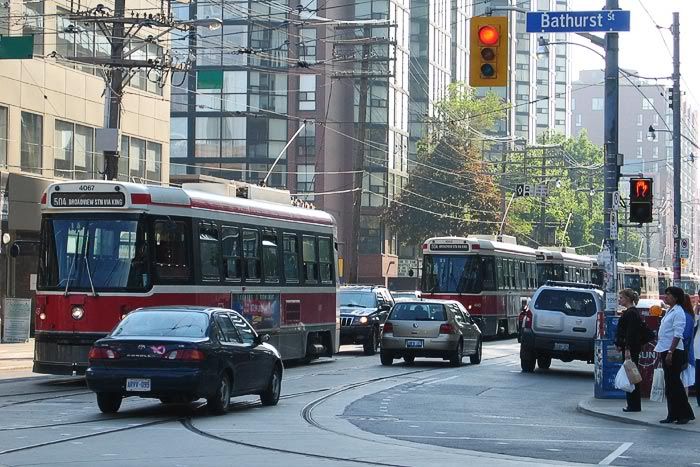
LRT (light rail transit) is another excellent way of getting people out of their Ford F-450’s. In my home town, the center of the universe, Toronto, the TTC has streetcars, which are a form of LRT but suffer the same fast as cars in the downtown core, since there is no separation from cars. Streetcars get stuck in traffic and end up become slow moving pylons. As mentioned before, I believe the answer to this problem once again lies in a dedicated transit lane so that regular car traffic isn’t a hindrance.

In a perfect world, everyone would ride motorcycles and not have to worry about taking up a lot of space on the road or searching for parking spots, but alas, this is Canada, with winter, so my little Utopian idea wont come to pass.
